BIBLIOGRAPHY
AND RESOURCES:
I
have discovered a plethora of information on the owners of Rossetti's
works, information that exists nowhere else. I have found this after
much googling online resources that included newspaper clippings,
Wikipedia, auction house provenance, the Rossettiarchives.org which
provides names but which is out of date, Virginia Surtees' catalog
raisonné that is also out of date. I have also used Blouin Art
sales Index, Redford, and Reitlinger. I have had help from curators
and archivists who provided information about Rossetti’s works in
their collections and about owners who donated or collected these
works.
A
useful online research source for converting historical prices is
Measuring Worth,
https://www.measuringworth.com/datasets/exchangeglobal/ My
data is a compilation of catalogues, Victorian writings, archival
research (Fogg, Delaware, Walters, Smithsonian Archives of American
Art online or microfilm archival sources), online and hard copy
catalogues from Sotheby's and Christie's, inquiries to archivists and
librarians and to Peter Nahum who has been very helpful. For their
tremendous help in tracking down owners and prices: Darragh
O'Donoghue, Archive Curator, Tate Library & Archive; Duncan
Walker, Curator, Russell-Cotes Art Gallery and Museum; Cristina
Meisner, Research Associate II, Harry Ransom Center; Simon Toll of
Sotheby's; Sarah Marden, Steward, and Michael Baxter, staff, Croft
Castle; Masako Kawaguchi, National Museum of Western Art, Tokyo;
Nadine Lees, Digital Media and Rights Officer, Birmingham Museums
Trust; Calvin Brown, Associate Curator of Prints and Drawings,
Princeton University Art Museum; Simona Dolari, Provenance
Researcher, Archives, Christie's; Katherine Wodehouse, Print Room
Supervisor, Ashmolean Museum; Anna Sander, Archivist and Curator of
Manuscripts, Balliol College, Oxford; Duncan Walker, Curator,
Russell-Cotes Art Gallery & Museum; Clare Keiller, Christie's.
Appadurai,
Arjun, “Commodities and the Politics of Value," in Appadurai,
ed., The
Social Life of Things.
Cambridge: Cambridge UP, 1988, 3-63.
“Art-Collector
William T. Walters" (Obituary), The
Literary Digest
10.6 (Dec 8, 1894), 8.
Bann,
Stephen, "Reassessing Repetition in Nineteenth-Century Academic
Painting: Delaroche, Gérôme, Ingres," in Eik Kahng, ed., The
Repeating Image: Multiples in French Painting from David to Matisse,
Exhibition catalogue, The Walters Art Museum, Baltimore. New Haven,
Yale UP, 2007, 27-52.
Bann,
Stephen. Distinguished
Images; Prints in the Visual Economy of Nineteenth-Century France.
New Haven and London: Yale UP, 2013.
Bann,
Stephen. Parallel
Lines: Printmakers, Painters and Photographers in Nineteenth-Century
France.
New Haven and London Yale UP, 2001.
Baudrillard,
J. Simulacra
and Simulation.
Trans S. Glaser. Ann Arbor: U of Michigan P, 1994.
Benjamin,
Walter,
“The Work of Art in the Age of Mechanical Reproduction,"
Illuminations,
Hannah Arendt, ed., trans. H. Zorn. London: Fontana, 1968, 214-18.
Bennett,
Mary.
Artists of the Pre-Raphaelite Circle: The First Generation.
London: Lund Humphries, 1988.
Bennett,
Mary. Ford
Madox Brown: A Catalogue Raisonné.
London: Yale University Press, 2010
Berg,
Maxine, "From Imitation to Invention," The
Economic History Review
55.1 (2002), 1-30.
Birnbaum,
Martin.
The Last Romantic.
NY: Twayne, 1960.
Boggs,
Jean Sutherland et al. Degas,
exhibition catalog, Galeries Nationales de Grand Palais, Paris, and
National Gallery of Canada, Ottawa. New York: Metropolitan Museum,
1988.
Bourdieu,
P. Field
of Cultural Production.
New York: Columbia University Press, 1993.
Briefel,
Aviva.
The Deceivers: Art Forgery and Identity in the Nineteenth Century.
Ithaca: Cornell UP, 2006.
Bronkhurst,
Judith. William
Holman Hunt: A Catalogue Raisonné,
2 vols. London: Mellon Centre, 2006.
Cannadine,
David, "Pictures Across the Pond: Perspectives and
Retrospectives," 19-20, in Reist,
Inge,
ed., British
Models of Art Collecting and the American Response.
Aldershot: Ashgate, 2014, 9-25.
Christie's.
Important
Victorian and British Impressionist Art,
catalogue of sale on Thursday 11 July 2013.
Christie's.
Victorian,
Pre-Raphaelite and British Impressionist Art, Including the
Collection of Virginia Surtees, catalogue
of sale on Tuesday, 17 June, 2014.
Codell,
Julie, "Martin Birnbaum," Art
Market Dictionary,
ed. J. Nathan. Berlin: De Gruyter, 2019, in press.
Codell,
Julie and Linda Hughes, eds. Replication
in the Long Nineteenth Century: Re-makings and Reproductions.
Edinburgh: University of Edinburgh Press, 2018.
Codell,
Julie, “Transatlantic Autograph Replicas and the Uplifting of
American Culture," in Julie Codell and Linda Hughes, eds.
Replication
in the Long Nineteenth Century: Re-makings and Reproductions.
Edinburgh: University of Edinburgh Press, 2018, 46-66.
Codell,
Julie, "'Second Hand Images,'" Visual
Resources,
26/3 (Sept 2010), 214-25.
Codell,
Julie, "Charles Fairfax Murray and the Pre-Raphaelite
'Academy'," Collecting
the Pre-Raphaelites.
Ed. M. F. Watson (Aldershot: Ashgate, 1997), 35-49.
Cohn,
Marjorie B., and Susan L. Siegfried. Works
by J.-A.-D. Ingres in the collection of the Fogg Art Museum.
Cambridge, MA: Fogg Art Museum, Harvard University Press, 1980.
Condon,
P. In
Pursuit of Perfection: The Art of J.-A.-D. Ingres.
Indiana UP, 1984 (exh. cat.)
Conisbee,
Philip, "Georges de La Tour: The Exhibition in Paris and Other
Matters," The
Burlington Magazine
140, No. 1140 (March 1998), 201.
Crichton-Stuart,
Anthony, and Anna Cunningham, Dante
Gabriel Rossetti: Proserpine.
London:
Agnews, 2016.
Davis,
Whitney. Replications:
Archeology,
Art History, Psychoanalysis.
University Park: The Pennsylvania State UP, 1996.
Deleuze,
Gilles. “Plato and the Simulacrum," trans. R. Krauss, October
27,
(1983), 45-56.
Deleuze,
Gilles. Difference
and Repetition.
Trans. Paul Patton. New York: Columbia UP, 1994.
De
Marchi, N. & S. Raux, eds. Moving
Pictures.
Turnhout, Belgium: Brepols, 2014.
Douglas,
Mary. Purity
and Danger:
An
Analysis of Concepts of Pollution and Taboo.
New York: Praeger, 1966.
Droth,
Martina and Michael Hatt, “The
Greek Slave by
Hiram Powers: A Transatlantic Object," Nineteenth-Century
Art Worldwide,
15.2 (Summer 2016): http://www.19th
c.-artworldwide.org/
summer16/droth-hatt-intro-to-the-greek-slave-by-hiram-powers-a-transatlantic-object
Dyer,
Jennifer. Serial
Images: The Modern Art of Iteration.
Berlin: LIT-Verlag, 2011.
Dzelzainis,
Ella and Ruth Livesey, "Introduction Transatlanticism:
Identities and Exchanges." 19:
Interdisciplinary Studies in the Long Nineteenth Century
9 (2009):www.19.bbk.ac.uk
Elliott
David
B. Charles
Fairfax Murray: The Unknown Pre-Raphaelite.
London: Oak Knoll, 2000.
Elzea,
Rowland, ed. "The Correspondence Between Samuel Bancroft, Jr.
and Charles Fairfax Murray 1892-1916," Delaware
Art Museum Occasional Paper
2 (Feb 1980), 79.
Feigenbaum,
Gail and Inge Reist, eds. Provenance:
An Alternate History of Art,
Los Angeles: Getty Research Institute, 2012.
Fennell,
Francis L., Jr. The
Rossetti--Leyland Letters: The Correspondence of an Artist and his
Patron.
Athens, OH: Ohio University Press, 1978.
Fletcher,
Pamela and Anne Helmreich, eds. The
Rise of the Modern Art Market in London,
1850-1939.
University of Manchester Press, 2011.
Fletcher,
Pamela, “Creating the French Gallery: Ernest Gambart and the Rise
of the Commercial Art Gallery in Mid-Victorian London,"
Nineteenth-Century
Art Worldwide
6. 1 (Spring 2007):
http://www.19thc-artworldwide.org/spring07/143-creating-the-french-gallery-ernest-gambart-and-the-rise-of-the-commercial-art-gallery-in-mid-victorian-london
Fletcher,
Pamela and Anne Helmreich, "Local/Global: Mapping
Nineteenth-Century London's Art Market," Nineteenth-Century
Art Worldwide,
11, No. 3 (Autumn 2012) ,http://www.19thc-artworldwide.org/
autumn12/fletcher-helmreich-mapping-the-london-art-market
Foster,
Sally. “Replication of things: the case for composite biographical
approaches," in Julie Codell and Linda Hughes, eds.
Replication in the Long Nineteenth Century: Re-makings and
Reproductions.
Edinburgh: Edinburgh University Press, 2018, 23-45.
Fredeman,
William, Roger Lewis, Jane Cowan, ed. in The
Correspondence of Dante Gabriel
Rossetti.
10 vols. Cambridge: D. S. Brewer, 2002-2015.
Frederick,
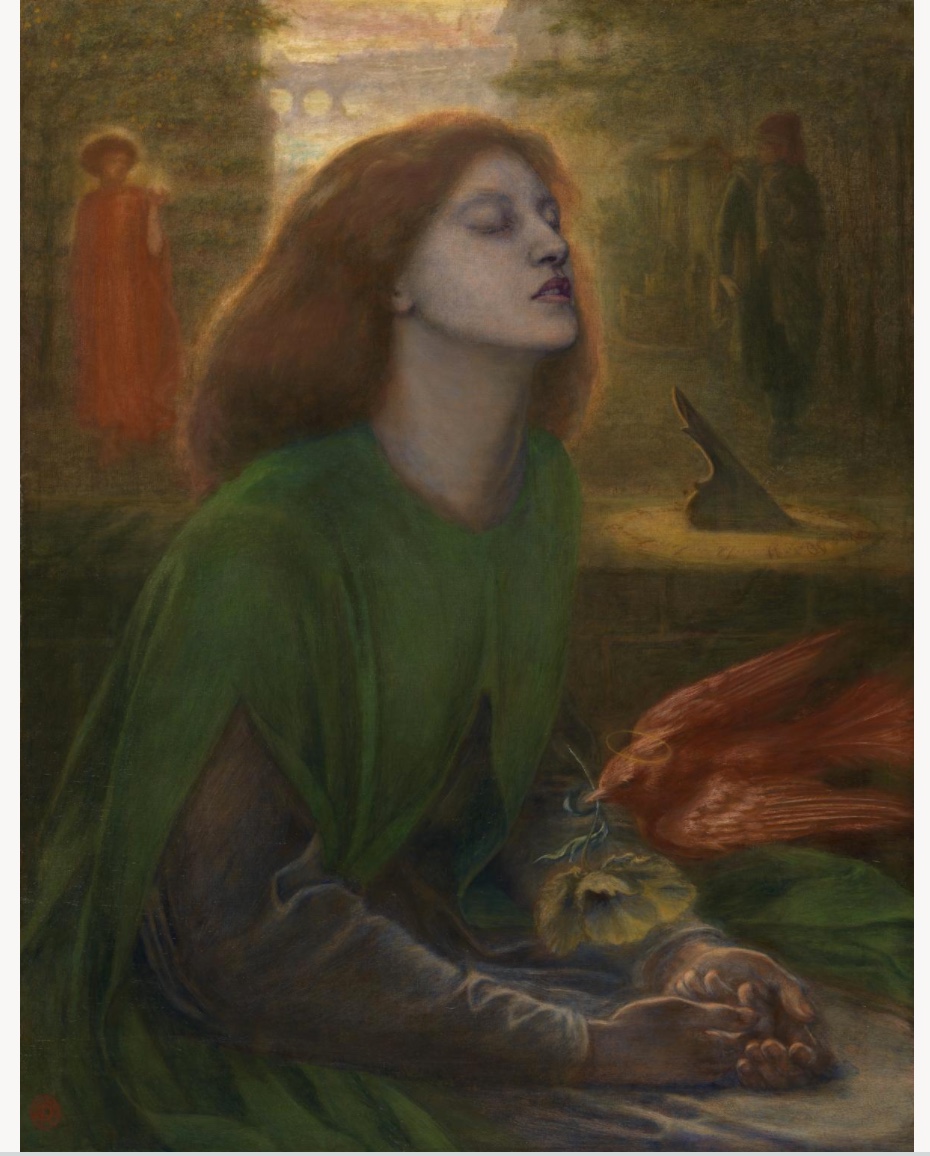
Margaretta, "The Replication of Dante Gabriel Rossetti's Beata
Beatrix--Demand
and
Desire,"
Review
of the Pre-Raphaelite Society
3 (Aut 2013): 27-41.
Freedberg,
David. The
Power of Images: Studies in the History and Theory of Response.
Chicago: University of Chicago Press, 1989.
Frith,
William Powell. My
Autobiography and Reminiscences.
2 vols. New York: Harper & Brothers, 1888.
Goffen,
Rona, “Icon and Vision: Giovanni Bellini's Half-Length Madonnas,"
The
Art Bulletin
57, no. 4 (Dec 1975): 487-518.
Gosden,
Chris and Yvonne Marshall, "Cultural Biography of Objects,"
World
Archaeology
31
(1999),
169-78.
Gramlich,
Johannes, “Reflections on Provenance Research: Values – Politics
– Art Markets," Journal
for Art Market Studies
2 (2017), 1-14. Gérôme & Goupil: Art and Enterprise. Exh. cat.
Trans. Isabel Ollivier. Paris: Réunion des musées nationaux, 2000.
Greenwald,
Diana Seave, "Colleague Collectors: A Statistical Analysis of
Artists’ Collecting Networks in Nineteenth-Century New York,"
Nineteenth-Century
Art Worldwide 17,
no. 1 (Spring 2018),
http:/www.19thc-artworldwide.org/spring18/greenwald-on-artists-
collecting-networks-in-nineteenth-century-new-york
Halliwell,
Stephen. The
Aesthetics of Mimesis: Ancient Texts and Modern Problems.
Princeton:
Princeton
UP, 2002.
Hansen,
Miriam Bratu, "Benjamin's Aura,"
Critical Inquiry 34
(Winter 2008): 336-75.
Harris,
Neil, "The Long Good-Bye: Heritage and Threat in Anglo-America,"
in Reist, ed., British
Models of Art Collecting and the American Response.
Aldershot: Ashgate, 2014, 195-208.
Haskell,
Francis. Rediscoveries
in Art.
Ithaca: Cornell UP, 1976.
Haverkamp-Begemann,
Egbert. With Carolyn Logan.
Creative Copies: Interpretative Drawings from Michelangelo to
Picasso. New
York: The Drawing Center and Sotheby's Publications, 1988.
Helmreich,
Anne ,“The Art Dealer and Taste: The Case of David Croal Thomson
and the Goupil Gallery, 1885-1897," Visual
Culture in Britain
6:2 (2005): 31-49.
Helmreich,
Anne, "Victorian Exhibition Culture: The Market Then and the
Museum Today,"
RAVON:
Romanticism and Victorianism on the Net
55 (August 2009),
https://www.erudit.org/fr/revues/ravon/2009-n55-ravon3697/039556ar/
Higonnet,
Anne, A
Museum of One's Own.
New York: Prestel, 2009.
Homburg,
Cornelia.
The Copy Turns Original: Vincent Van Gogh. Amsterdam:
John Benjamins, 1996.
Hoskins,
Janet. “Agency, Biography and Objects," Handbook
of Material Culture.
Chris Tilley, Webb Keane, Susanne Küchler, Patricia Speyer, eds.
London: Sage, 2006. 74-84.
Humphries,
Lance, “British Aspirations on the Chesapeake Bay: Robert Gilmor,
Jr. (1774–1848) of Baltimore and Collecting in the Anglo- American
Community of the New Republic.” British
Models of Art Collecting and the American Response.
Ed. Inge Reist. Aldershot: Ashgate, 2014: 147–62.
Hunt,
William Holman, Pre-Raphaelitism
and the Pre-Raphaelite Brotherhood.
2 vols. London: Macmillan, 1906.
Joyce,
Rosemary A. "From Place to Place: Provenience, Provenance, and
Archaeology," in Feigenbaum and Reist, 48-60.
Joyeux-Prunel,
Béatrice, "Circulation and the Art Market," Journal
for Art Market Studies
2 (2017), https://www.fokum-jams.org/index.php/jams/article/view/13
Joyeux-Prunel,
Béatrice, Catherine Dossin & Sorin Adam Matei, "Spatial
(Digital) History: A Total Art History?—The Artl@s Project,"
Visual
Resources
29:1-2 (2013), 47-58.
Kahng,
E., ed. The
Repeating Image.
New Haven: Yale UP, 2007.
Krauss,
R. The
Originality of the Avant-Garde and Other Modernist Myths.
MIT Press, 1986.
Kelly,
Simon, "'Strategies of Repetition': Millet/Corot," in Eik
Kahng, ed., The
Repeating Image: Multiples in French Painting from David to Matisse.
Exh. cat. The Walters Art Museum, Baltimore. New Haven, Yale UP,
2007, 53-81.
Lepine,
Ayla, Matt Lodder, Rosalind Mckeer, eds. Revival:
Memories, Identities, Utopias.
London: Courtauld Books Online, 2015.
courtauld.ac.uk/research/courtauld-books-online
Life,
Allen, "The Oil Versions of Rossetti's Proserpine" [Appendix
2], in The
Correspondence of Dante Gabriel Rossetti, ed.
William Fredeman (Cambridge: D. S. Brewer, 2006) 6, part 1: 588-604.
Macfarlane,
R. Original
Copy: Plagiarism & Originality in 19th-C. Literature.
Oxford UP, 2007.
Macleod,
Dianne Sachko. Art
and the Victorian Middle Class: Money and the Making of Cultural
Identity.
Cambridge: Cambridge University Press, 1996.
Mainardi,
P., “Copies, Variations, Replicas," Visual
Resources
15 (1999), 123-47.
Mainardi,
P. “Impressionist Replication," Ján Bakos, ed. Artwork
Through Market.
Bratislava, 2004, 155-72.
Mainardi,
P., “Déjà vu exhibition review," 19th-C.
Art Worldwide,
7/1 (2008), Online journal.
http://www.19thc-artworldwide.org/40-spring08/spring08review/102-deja-vu-revealing-repetition-in-french-masterpieces
Mainardi,
P.
Another World: Nineteenth-Century Illustrated Print Culture.
New Haven: Yale UP, 2017.
Malton,
Sara.
Forgery
in Nineteenth-Century Literature and Culture. New
York: Palgrave Macmillan, 2009.
Marsh,
Jan. Dante
Gabriel Rossetti: Painter and Poet.
London: Weidenfeld & Nicolson, 1999.
Massimi,
Brian, "Realer Than Real," Copyright
no. 1 (1987), 90-99.
http://www.brianmassumi.com/textes/REALER%20THAN%20REAL.pdf
Millhauser,
Steven, "Replicas," Yale
Review
83.3 (July 1995): 50-61.
Mills,
Ernestine. The
Life and Letters of Frederic Shields, 1833–1911.
London: Longmans, Green, 1912.
Miner,
Dorothy, "The Publishing Ventures of a Victorian Connoisseur: A
Sidelight on William T. Walters," The
Papers of the Bibliographical Society of America
57.3 (Third Quarter, 1963), 271-311.
Moss,
Dorothy, “Translations, Appropriations, and Copies of Painting."
Ph.D. diss, U of Delaware, 2012.
Murray,
Charles Fairfax. Collection
J. Pierpont Morgan: Drawings by the Old Masters, formed by C. Fairfax
Murray.
London; Privately printed, 1905-1912.
Nahum,
Peter. Pre-Raphaelite,
Symbolist, Visionary.
Catalogue of exhibitions in New York and London, May 11-July 7,
2001.
National
Gallery of Art, Washington. Retaining
the Original: Multiple Originals, Copies and Reproductions.
Hanover and London: University Press of New England, 1989.
Orvell,
Miles. The
Real Thing: Imitation and Authenticity in American Culture.
U of No. Carolina, 1989.
Peattie,
Roger, ed. Selected
Letters of William Michael Rossetti.
Penn State UP, 1990.
Pergam,
Elizabeth A., "Provenance as Pedigree: The Marketing of British
Portraits in Gilded Age America," in Feigenbaum and Reist,
104-22.
Emily
Pugh, “Nineteenth-Century
Art Worldwide’s
‘Digital Humanities and Art History’: Reflections on Our First
Articles,” Nineteenth-Century
Art Worldwide 15,
no. 1 (Spring 2016),
http://www.19thc-artworldwide.org/spring16/pugh-on-digital-humanities-art-
history-our-first-articles
Rathbone,
E. et al. Van
Gogh Repetitions.
New Haven: Yale UP, 2013 (exh. cat.).
Raux
Sophie, "From Mariette to Joullain: Provenance and Value in
Eighteenth-Century French Auction Catalogs," in Feigenbaum and
Reist, 86-103.
Redford,
George. Art
Sales. A History of Sales of Pictures and other Works of Art,
2 vols. London, 1889.
Redgrave,
Frances Margaret. Richard
Redgrave, C.B., R.A.: A Memoir Compiled from his Diary.
London: Cassell & Co., 1891.
Reisinger,
Y. and C. Steiner, "Reconceptualizing Object Authenticity,"
Annals
of Tourism Research
33.1 (2005), 65-86.
Reist,
Inge, "Introduction," in Reist, ed., British
Models of Art Collecting and the American Response.
Aldershot: Ashgate, 2014, 1-6.
Reitlinger,
Gerald, The
Economics of Taste.
New York: Holt, Rinehart and Winston, 1964.
Renié,
Pierre-Lin, "The Image on the Wall: Prints as Decoration in
Nineteenth-Century Interiors," NCAW
5.2 (Aut 2006), at
http://www.19thc-artworldwide.org/autumn06/49-autumn06/autumn06article/156-the-image-on-the-wall-prints-as-decoration-in-nineteenth-century-interiors
Reynolds,
Ada M. The
Life and Work of Frank Holl.
London: Methuen, 1912.
Rodríguez-Ortega, Nuria,
"Canon, Value and Artistic Culture: Critical Inquiry about the
New Processes of Assigning Value in the Digital Realm," Digital
Humanities,
University of Lausanne, at
http://dharchive.org/paper/DH2014/Paper-734.xml
Rosenthal,
Gertrude, et al. The
George A. Lucas Collection of The Maryland Institute.
Exh. cat. Baltimore: The Baltimore Museum of Art, 1965.
Rossetti,
Dante Rossetti. Dante
Gabriel Rossetti. His Family Letters.
2 vols. London: Ellis and Elvey, 1895.
Rossetti,
William Michael. The
Diary of William Michael Rossetti, 1870-1873,
ed. Odette Bornand. Oxford: Oxford UP, 1978.
Royal
Academy of Arts. Pre-Raphaelite
and Other Masters: The Andrew Lloyd Webber Collection.
Catalogue, 20 September-12 December 2003.
Saffo,
Paul, "The Place of Originality in the Information Age," in
Bierut, Michael, W. Drenttel,
S.
Heller, D. K. Holland, eds. Looking
Closer 2.
New York: Allworth Press, 1997, 94-96.
Secrest,
Meryle. Duveen:
A Life in Art.
Chicago: University of Chicago Press, 2004.
Seligmann,
Germain. Merchants
of Art: 1880-1960.
New York: Appleton-Century-Crofts, 1961.
Shiff,
Richard. “The Original, the Imitation, the Copy…," Yale
French Studies
66 (1984), 27-54.
Sotheby's.
Art
at Auction, 1989-90.
London and New York: Sotheby's Publications and Rizzoli, 1989.
Sotheby's.
Art
at Auction, 1988-89.
London and New York: Sotheby's Publications and Harper & Row,
1990.
Sotheby's.
British
Art, Victorian and Edwardian Art.
Sale catalogue London 11 December 2007.
Spear,
Richard E. "Guercino's 'prix-fixe': Observations on Studio
Practices and Art Marketing in Emilia," The
Burlington Magazine
136, No. 1098 (Sept 1994), 586.
Stansbie,
Eleanor Fraser, “Christianity, Masculinity, Imperialism: The
Light of the World
and Colonial Contexts of Display," in Amelia Yeates and Serena
Trowbridge, eds. Pre-Raphaelite
Masculinities: Constructions of Masculinity in Art and Literature.
Farnham: Ashgate, 2014, 189-212.
Stephens,
F. G. Dante
Gabriel Rossetti.
London: Seeley and Co., 1896.
Stockhammer,
Philipp W. and Corinna Forberg, “Introduction," The
Transformative Power of the Copy,
eds. Stockhammer and Forberg Heidelberg UP, 2017, 1-17.
Surtees,
Virginia, Dante
Gabriel Rossetti, 1828-1882, The Paintings and Drawings: A Catalogue
Raisonné.
2 vols. Oxford: Clarendon Press, 1971.
Tate
Papers
Issue 8 on replicas (2007):
http://www.tate.org.uk/research/publications/tate-papers/issue-08
Taussig,
Michael. Mimesis
and Alterity.
London: Routledge, 1993.
Thomas,
David Wayne, "Replicas and Originality: Picturing Agency in
Dante Gabriel Rossetti and Victorian Manchester," Victorian
Studies
43/1 (Autumn 2000), 67-102.
Tucker,
Paul, "'Responsible Outsider': Charles Fairfax Murray and the
South Kensington Museum," Journal
of the History of Collections
14.1 (2002): 115-37.
von
Hadeln, Detlev Baron, "Originals and Replicas from Tintoretto's
Studio," The
Burlington Magazine for Connoisseurs
43, No. 249 (Dec 1923), 286.
Verhoogt,
Robert. Art
in Reproduction: Nineteenth-Century Prints after Lawrence
Alma-Tadema, Jozef Israëls, and Art Scheffer.
Amsterdam: Amsterdam UP, 2007.
Ward,
G., ed. The
Eye of the Beholder: Fakes, Replicas, and Alterations.
Yale Art Gallery, 1977.
Whyte,
Ryan, “Repeat Performance: Chardin's Aesthetics of Repetition in
the Paris Salons," RACAR:
Revue d'art Canadienne/Canadian Art Review
36, No. 1 (2011): 51-62.
Wolohojian,
Stephan. A
Private Passion: 19th–Century Paintings and Drawings from the
Grenville L. Winthrop Collection.
Exh. cat. New York: Metropolitan Museum, 2003.
Wood,
Christopher. Forgery
Replica Fiction.
Chicago: U of Chicago Press, 2008.